TDS on Sale of Property in India
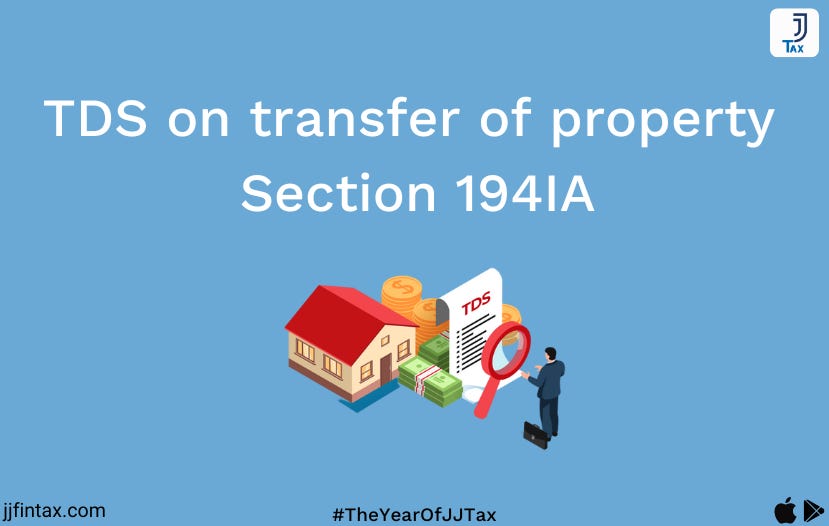
Tax Deducted at Source (TDS) on the sale of immovable property is governed by the Income Tax Act, 1961. As per Section 194-IA, when an immovable property (other than agricultural land) is sold for more than ₹50 lakh, the buyer must deduct TDS at the time of making payment to the seller. This rule ensures transparency in high-value property transactions and compliance with income tax laws. The TDS rate under Section 194-IA remains 1% of the total sale consideration or the stamp duty value (whichever is higher).
Key Points on TDS Applicability
1. Threshold Limit
- TDS applies if the sale consideration or stamp duty value of the property is ₹50 lakh or more.
- If the amount is less than ₹50 lakh, or if the property is agricultural land (as defined in Section 2(14)(iii)), TDS does not need to be deducted.
2. Sale by NRI (Non-Resident Indian)
When a property is sold by an NRI, the transaction is governed by Section 195 instead of Section 194-IA.
- For long-term capital gains (held > 24 months), the TDS rate is 12.5% (plus surcharge and 4% cess) — effective from 23 July 2024.
- The effective deduction rate typically comes to around 14.95% depending on income level.
- For short-term capital gains (held ≤ 24 months), TDS is deducted at the applicable slab rate of the NRI (which may go up to 30% + surcharge + cess).
- No minimum threshold applies for NRI transactions — TDS must be deducted even if the sale value is below ₹50 lakh.
- The NRI seller can apply to the Assessing Officer for a lower or nil TDS certificate.
3. Buyer’s Responsibility
- The buyer must deduct TDS at the time of payment or credit, whichever is earlier.
- The deducted TDS must be remitted to the government within 30 days from the end of the month in which the deduction was made.
- The buyer should ensure the seller’s PAN is correct before making the payment.
4. PAN Requirement
The seller must provide their Permanent Account Number (PAN) to the buyer.If the seller fails to provide a PAN, the TDS rate increases to 20% under Section 206AA. The PAN must also be quoted in Form 26QB and Form 16B.
TDS Certificate and Compliance Requirements
Form 26QB
- Form 26QB is the TDS challan-cum-statement for reporting and paying TDS on property purchases under Section 194-IA.
- It must be filed within 30 days from the end of the month in which TDS was deducted.
- The buyer must provide details such as:
- PAN of both buyer and seller
- Property address and type
- Sale consideration and TDS amount
- Mode of payment and contact details
- The payment can be made online via net banking, debit card, or other authorised payment options on the TIN-NSDL portal.
- After payment, a challan counterfoil with a unique acknowledgment number is generated. This number is needed to download the TDS certificate.
Form 16B
- After filing Form 26QB and depositing the TDS, the buyer must issue Form 16B to the seller.
- Form 16B can be downloaded from the TRACES (TDS Reconciliation Analysis and Correction Enabling System) portal.
- The buyer must issue this certificate to the seller within 15 days from the due date of filing Form 26QB.
- The certificate serves as proof of TDS deduction and deposit, which the seller can claim as a tax credit while filing their income tax return.
TAN Requirement
- For resident property transactions (under Section 194-IA), the buyer does not need a TAN (Tax Deduction Account Number). PAN is sufficient.
- For property purchases from NRIs (under Section 195), the buyer must obtain a TAN to deduct and remit TDS.
- If there are multiple buyers, each must obtain a separate TAN for their respective portion.
Filing TDS Returns
The buyer must file:
- Form 26QB for transactions with resident sellers.
- Form 27Q for transactions with non-resident sellers (NRIs).
Both forms must be filed within 30 days from the end of the month in which TDS was deducted.
Delay or failure to file TDS returns can attract interest and penalties under Sections 234E and 271H.
Using Form 16B for Tax Credit
Form 16B acts as evidence that TDS was deducted and deposited with the government.
The seller can use this certificate while filing their Income Tax Return (ITR) to claim TDS credit against their total tax liability for the year.
To Wrap-up
TDS on the sale of property is a vital compliance step that protects both buyers and sellers from future tax disputes. Whether you’re a first-time buyer or managing multiple investments, staying updated on TDS rules helps you stay ahead of any discrepancies that may arise.